
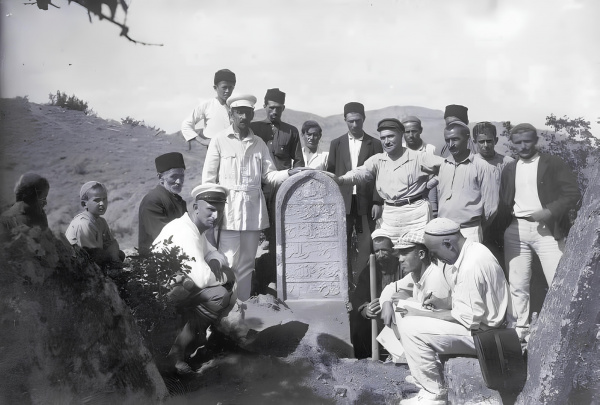
Members of the Solkhat expedition of the All-Union Scientifi c Association of Oriental Studies at the cemetery in Otuz at the gravestone of Sheikh Yaqub Koniysky. (Miras–Nasledie..., 2016, p. 493, fi g. 491)
At the almost century-old photograph from 1926, the gravestone of the righteous Sheikh Yaqub Koniysky is frozen in the center of the frame. Around the monument, against the backdrop of the majestic Mount Arda-Kaya, are captured the participants of the Solkhat expedition. Among them are the archaeologist Ilya Borozdin, the poet Osman Akchokrakly and Usein Bodaninsky, founder of the Bakhchisaray Museum. Scientists arrived in the village of Otuz (now Shchebetovka) to explore the medieval past of this corner of southeastern Crimea.
Solkhat – this is what the Genoese called the city of Kyrym, the capital of the Crimean ulus of the Golden Horde (now Stary Krym). To the south, in the valley of the Otuzka River, there was the village of Otuz, connected to the capital by trade routes. Through the southern fortress gates of Solkhat there was a highway to Otuz, where there was a port, giving the settlement strategic importance.
Even before the expedition began, Osman Akchokrakly discovered three unique monuments here: the gravestone of Sheikh Yaqub Koniysky, "the martyr Idris, son of Haji Yahya Otuzsky" and "the righteous Sheikh Haji Yahya, son of Muhammad Iraqsky".
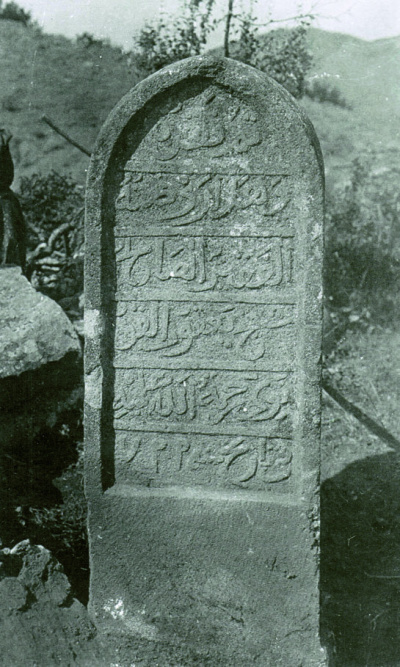
Gravestone of Sheikh Yaqub Koniysky, 729 AH. Photo. 1926 (Miras-Nasledie..., 2016, p. 486, fi g. 484)
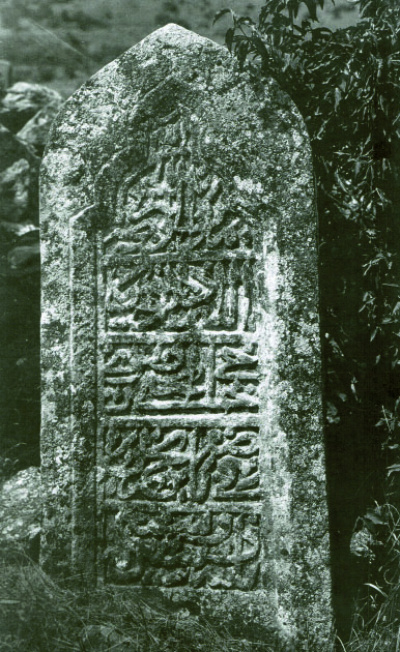
Gravestone of Idris, son of Haji Yahya Otuzsky, 763 AH. Photo. 1926 (Miras–Nasledie..., 2016, p. 489, fi g. 487)
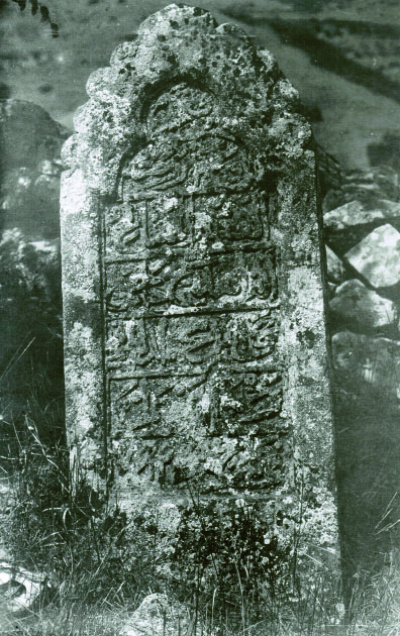
Gravestone of Sheikh Haji Yahya, son of Muhammad Iraqsky, 782 AH. Photo. 1926 (Miras–Nasledie..., 2016, p. 492, fi g. 490)
These finds, dating back to the 14th century, were complemented by a foundation slab with an Arabic inscription: "This blessed well <…> was built by Idris, son of Haji Yahya, 760 AH". It is possible that Idris, mentioned on the slab and the gravestone, is one and the same person.
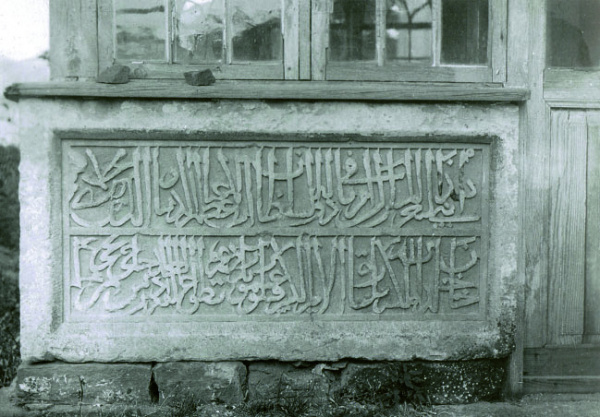
Inscription on the slab, tell-ing about the construction of the fountain by Idris, son of Haji Yahya, 760 AH. Photo. 1926 (Miras–Nasledie..., 2016, p. 488, fi g. 486)
Ilya Borozdin suggested that the slab marked the boundary of a tekiye, a dervishes' abode. The titles "sheikh" on the gravestones indicated the possible existence of a Sufi monastery in Otuz, where preachers from Seljukia - Konya and Iraq came. Usein Bodaninsky copied the monuments, indicating the place of their discovery: Beshik -Aziz. "Beshik" means cradle; “Aziz” in Crimean Tatar culture are holy places.
After the Great Patriotic War, fragments of the monuments were used as building material. Only in the 1990s, local residents accidentally discovered parts of tombstones in an old fence on Lenin Street. In 2017, employees of the Sh. Marjani Institute of History identified fragments of Golden Horde gravestones described by Akchokrakly among the debris. Bodaninsky's sketches helped - they also allowed identifying fragments of a sarcophagus with "horns" found by an expedition in 1926.
The style of the gravestones is typical for Muslim monuments of Crimea. Their manufacture is attributed to Solkhat carvers - the capital of the ulus was famous for its stone-cutting craft. The influence of large Muslim institutions in Kyrym cannot be ruled out. Similar examples of gravestones are found in the Kyrk-Azizler necropolis on the territory of modern Bakhchisaray. The population of the peninsula copied and reproduced the expressiveness and sophistication of Seljuk carving.
It is noteworthy that both sheikhs, Yaqub Koniysky and Haji Yahya, were from Anatolia and Iraq. Their presence on the peninsula indicates that Otuz could have been a religious center in the 14th century. The proximity to Solkhat provided support from the authorities, and the nature of the picturesque valley protected from the enemy and hid from prying eyes, creating ideal conditions for spiritual solitude.
Today Shchebetovka is a quiet resort village famous for its nature reserve in the Kara-Dag Mountain range. Another attraction is Otuz-Jami, built during the Russian Empire. Before the construction of the cathedral mosque in Simferopol, the Otuz-Jami minaret was the tallest in Crimea. It was here that a 14th-century slab was discovered, which was moved here before the Solkhat expedition. Research into the Golden Horde heritage continues, including under the auspices of the Vernadsky Crimean Federal University.
GSV "Russia - Islamic World"
Photo in slider: Sheet XLIV, DuBois de Montperreux, 2009, color insert