
The Group of Strategic Vision “Russia – Islamic World” (Group) held its final event of the year in Moscow. The event focused on the role of historical heritage in contemporary dialogue. Participants in the scientific and practical conference "Dialogue 'Russia-Islamic World'" included government officials, diplomats, and religious leaders. They discussed the 950th anniversary of the founding of the Nizamiyya Madrasah in Dagestan, Kazan's upcoming designation as the cultural capital of the Islamic world in 2026, and the importance of education as the foundation of intercivilizational partnership.
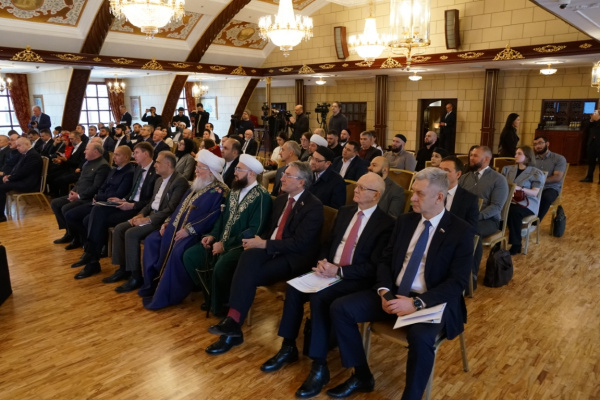
In his welcoming address, Rustam Minnikhanov, Rais of the Republic of Tatarstan and Chairman of the Group of Strategic Vision “Russia – Islamic World”, recalled the deep historical roots of the dialogue between Russia and the Islamic world. "This is the interaction of long-established civilizations that have formed a common cultural and historical space in Eurasia."

"Our country is home to millions of Muslims. And Islam is an integral part of its historical and cultural heritage. And we see strategic potential in this partnership," the Group's chairman stated.
Minnikhanov also announced a significant upcoming event that will highlight Russia's role in the Islamic world: the decision to designate Kazan, the capital of Tatarstan, as the cultural capital of the Islamic world in 2026.
"I am convinced that a sustainable and trusting dialogue between Russia and the Islamic world is only possible if we build on the crucial intersection of the history and culture of our peoples," Minnikhanov expressed confidence, noting the relevance of educational and enlightening discussions.
In conclusion, he announced an agreement to organize a working visit by the Group to Dagestan. The purpose of the trip will be to attract attention and promote the participation of the Muslim community in projects to preserve and restore the Nizamiyya Madrasah.
Deputy Chief of Staff Magomedsalam Magomedov presented the official position of the Presidential Administration of the Russian Federation on interethnic and interfaith harmony. He discussed, in particular, work with such organizations as the Group of Strategic Vision “Russia – Islamic World”.

Expanding on the topic of Russia's religious policy, Magomedov noted that as early as the 19th century, the country's Muslim communities realized that the key to progress lay in a renewed system of religious education. It was then that secular studies and the study of the Russian language began to be actively integrated into madrasah's educational programs. This historical experience, he argued, today serves as an important foundation for state policy aimed at strengthening pan-Russian civic identity and countering extremism.
"Russia is always open to those who are willing to build partnerships based on the principles of equality, mutual respect, justice, and multipolarity," Magomedov stated. He noted that Russia, which has developed over centuries as a union of peoples of different faiths, systematically supports traditional religions, which has become a resource for its resilience and inner strength.
Ambassador Extraordinary and Plenipotentiary of the Islamic Republic of Iran to the Russian Federation Kazem Jalali emphasized in his address that his presence is not only a political but also a cultural representation of a civilization that has deep historical ties with Russia.

Noting the revolutionary role of the madrasah system established in the 5th century AH by the statesman Nizam al-Mulk at -Tusi, the diplomat said: “Nizam al- Mulk, by founding the network of Nizamiyya madrassas in Baghdad, Nishapur, Isfahan and Balkh, created the first centralized state educational system.”
He identified key innovations: the institutionalization of education with scholarships and housing for students, making education accessible to all segments of society; a clear curriculum that included secular sciences in addition to Islamic law; and the training of administrative personnel to govern the empire.
"The Nizamiyya was not just a school, but a social and intellectual network that united the elite of the Islamic world. The influence of these madrassas was so profound that it gave the world such great figures as Imam Muhammad al-Ghazali and Saadi Shirazi," recalled Kazem Jalali.
The diplomat emphasized that the scientific light of these centers quickly reached the Caucasus, where the Nizamiyya madrassas also existed and became centers of education. Inscriptions in Persian and Arabic in ancient mosques in Dagestan and Tatarstan testify that the language of science was then the language of interaction and friendship.
"Today, as the world struggles with extremism and ignorance, recognizing the scholarly tradition in which the pen prevailed over the sword is vital for all of us," Jalali said, adding that academic cooperation between Tehran and Moscow, especially with the North Caucasus republics, can guarantee the security and sustainable development of these regions.
Key government agencies — the Department for Interaction with Religious Organizations and the Presidential Executive Office for Domestic Policy — are actively collaborating with the Group of Strategic Vision “Russia – Islamic World”. A special partnership has been established with the Foundation for the Support of Islamic Culture, Science, and Education, whose Chairman of the Board, Evgeny Eremin, also addressed the participants.

"The religious sphere in the Russian Federation is very vibrant, deep, and diverse," Eremin emphasized. The Russian Ministry of Justice, which is responsible for this registration, maintains a registry of approximately sixty religious denominations and also separately registers approximately twenty organizations representing movements such as shamanism or ethnic beliefs.
"Perhaps the Almighty Creator endowed our multinational and multireligious people with such inquisitiveness and a desire to explore spiritual truths. And this has always been done at the highest level," Eremin suggested.
A striking example of this commitment to excellence is the emergence of the Nizamiyya Madrasah in the highlands of Tsakhur. Eremin urged us to imagine how, relatively recently, the Revelation was revealed to the Prophet Muhammad, and soon after, high in the mountains, the first religious and secular university emerged.
"This is a characteristic of our people. That's why we continue to strive to raise our religious education system to the same high level," he said.
Eremin recalled that in 2013, in Ufa, Russian President Vladimir Putin, speaking at the Council on Interethnic Relations, set the goal of developing domestic Islamic education, "so that we would not be ashamed of our ancestors, who received a high education at mining universities, where they also studied secular sciences."
According to him, Russia has a Council for Islamic Education that strives to ensure that Islamic universities are high-quality and teach not only religious but also secular subjects. The main goal is to cultivate Russian patriots and foster a sense of civic identity in future religious leaders.
Eremin added that over millennia of interaction, the spiritual values of the peoples of Russia, rooted in religion, have become common to all. These values are also shared by friendly neighboring peoples. Speaking about the Group's work, he cited an example: the management of the Islamic Development Bank, after listening to his account of the values and history of Derbent, asked to see a recording of President Vladimir Putin kissing a gifted Quran in an ancient mosque. The recording made a profound impression.
"Our unity is inviolable. This spiritual treasure—the friendship of peoples—is being defended today by our brothers during a special military operation. The Almighty, who gave us this treasure, will not allow it to disappear. Our legacy will be remembered and developed by each new generation," Eremin expressed hope.
Mufti Shafig Pshikhachev, Chairman of the Centralized religious organization "International Islamic Mission", shared his impressions of a recent trip to Dagestan, where he had the opportunity to perform Friday prayers in a 950-year-old building in the highland village of Tsakhur.

"It's hard to disagree with the fact that Derbent and Ancient Bolgar are historical centers for the spread of Islam, Islamic science, culture, and education not only in Dagestan and the Volga region, but also in Russia as a whole," the mufti emphasized.
Pshikhachev described the Tsakhur madrasah "Nizamiyya", opened 13 years before the University of Bologna, as one link in a network of educational institutions in Baghdad, Nishapur, and other cities. Unfortunately, many valuable manuscripts were lost during wars and the period of state atheism in the USSR. However, the building itself, where history, arithmetic, medicine, and poetry were taught alongside religious subjects, survived.
The mufti also addressed the contemporary agenda, quoting Vladimir Putin's words from a 2013 meeting: "Islam has become a significant factor in socio-political life and has made an invaluable contribution to the spiritual and cultural development of our society."
Pshikhachev noted that Russian Islam, drawing on centuries of domestic experience, has every opportunity for development. The most important task is to recreate a recognized Islamic theological school of its own, which will ensure the sovereignty of Russia's spiritual space. "This school must respond to the most pressing events both in Russia and globally, providing its own assessments that will be understandable and authoritative for believers," Pshikhachev stated.
The event was organized by the Russian Academy of Sciences (RAS). On behalf of the Academy, Alikber Alikberov, Director of the RAS Institute of Oriental Studies, welcomed the conference participants.

"We turn to history to look to the future and build new actions," he noted, adding that an important part of this history is the spread of Islam in Russia, including sacred dates and educational traditions.
Alikberov emphasized the establishment of the Nizamiyya Madrasah in the Dagestani village of Tsakhur. He noted that the significance of this event may be somewhat exaggerated in the public sphere, but its role as a center of knowledge is undeniable. "The fact remains that the madrasah was called Nizamiyya. It operated, and many graduates from there went on to study elsewhere," he stated.
This historical legacy, Alikberov explained, creates strategic depth in Russia's relations with the Islamic world, providing the opportunity to better see the future by drawing on the larger trajectory of the past.
Alikberov also emphasized the urgency of rebuilding the theological school and the importance of turning to historical texts, such as the book "Asari Dagestan" by Dagestani educator Gasan Alkadari. "The return of this tradition will fill the gap we have, and we will have a more powerful, serious, and solid foundation for further progress," he concluded.
The Institute of Oriental Studies' publishing activities were presented, along with a new book, "Mountain Jewish Epigraphy of Dagestan". The publication illustrates the unique Dagestani model of interethnic harmony. "Keep in mind that no matter who ends up in Dagestan, they ultimately become Dagestani. This is important," Alikberov noted.
In conclusion, the Director of the Institute of Oriental Studies announced the conference program, which included two sessions: a scientific session devoted to analyzing historical facts and myths, and an analytical session aimed at finding solutions for Russia's modern development based on historical experience.


The conference's academic session included a discussion challenging popular myths about the Nizamiyya Madrasah in Tsakhur as the "first university of Dagestan," founded in 1075. It was noted that a key Arabic source describes it rather as an educational institution built by the vizier Nizam al-Mulk, where important translation work into the local language was conducted. Scholars concluded that it was likely a peripheral branch of a large network of madrassas created to strengthen Sunni Islam and combat Shiism on the borders of the caliphate. The choice of Tsakhur, like Ganja, is explained by the legacy of these places as centers of earlier Christian literary culture.
The conference not only paid tribute to ancient educational traditions but also clearly identified their direct connection to pressing contemporary challenges: strengthening the sovereignty of Russia's spiritual space, developing a national Islamic theological school, and nurturing a new generation of religious leaders in the spirit of civic patriotism. As the event demonstrated, turning to shared history remains a key resource for building a sustainable dialogue between Russia and the Islamic world and consolidating Russia's multinational society.
GSV "Russia - Islamic World"