
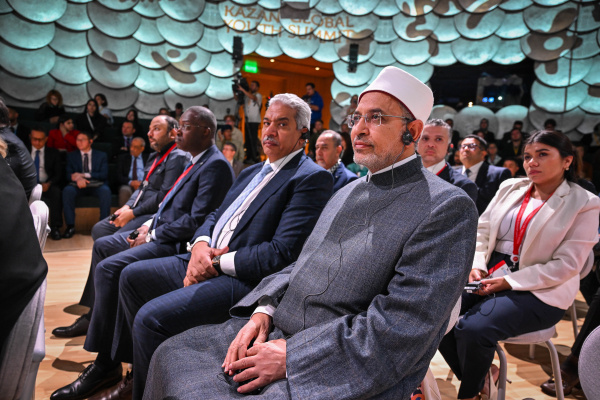
On August 29, Rais of Tatarstan Rustam Minnikhanov and Russia’s Minister of Science and Higher Education Valery Falkov participated in the plenary session of the 4th Kazan Global Youth Summit. The event took place in the Eastern Hall of the new Kamal Theater in Kazan, with the focus on “Education of the Individual in an Era of Global Change: Values and Career Paths.”
During his opening remarks, Rustam Minnikhanov thanked Valery Falkov, federal partners, and Isamic Cooperation Youth Forum President Taha Ayhan for their support and trust. “Thanks to the backing and patronage of the Ministry of Science and Higher Education, this summit has achieved federal status. Alongside youth ministers and leaders of youth organizations, this year’s summit actively involves education ministers, university rectors, and scientists from 45 countries—a remarkable turnout!” he said.
He stressed that in times of rapid change, education plays a critical role in ensuring stability not only for individuals but for entire nations. “It’s not just about acquiring knowledge. It’s about establishing firm value systems, and nurturing responsible, patriotic and socially conscious citizens. Our shared goal is to build a system where every young person can find their own individual path, both professionally and personally. A system where traditional values—respect for family, work and culture—go hand in hand with modern career opportunities,” Minnikhanov remarked.
The head of Tatarstan also noted that the region’s universities have become increasingly popular among international students, with around 22,000 currently studying there.
Minnikhanov spoke about strengthening international youth cooperation between Russia, the Islamic world and BRICS countries. “Every year, specialized youth platforms for young diplomats and entrepreneurs are held within the international forum ‘Russia – Islamic World: KazanForum.’ This year, the Group of Strategic Vision ‘Russia – Islamic World,’ which I have the honor to lead on behalf of President Putin, focused on youth policy and commemorated the 80th anniversary of our country’s victory in the Great Patriotic War. It is vitally important for youth to understand the value of peace achieved at such tremendous cost by our ancestors. Knowledge and respect for history foster patriotism and a sense of responsibility for the future,” he said.
He praised efforts to create more conditions for educating young people based on traditional values. “Our NGOs and youth organizations, young scientists’ communities, families, and rural youth all contribute greatly to civil society. The nationwide movement ‘Movement of the First,’ chaired by President Vladimir Putin, plays a key role in youth development. It’s about consolidating all state and social structures. Our work begins as early as kindergarten, with active involvement from educators and parents,” Minnikhanov emphasized.
Closing his remarks, Minnikhanov reflected on the summit’s theme: “Education of the Individual in an Era of Global Change is highly relevant. I am confident that the discussions have been fruitful. For us, exchanging best practices in training specialists, fostering future generations and creating optimal conditions for youth potential is of utmost importance. I wish all delegates productive work and successful implementation of joint projects.”

Speaking next, Minister Valery Falkov highlighted Kazan’s extensive experience hosting international events, especially those organized as part of Russia’s BRICS chairmanship. “Today, representatives from more than 20 foreign countries have gathered here. Undoubtedly, youth development is a top priority in Russia’s national strategy. The youth are our future, and humanity as a whole faces unprecedented challenges: climate change, technological transitions, and shifting centers of global power. Meeting these challenges requires preparing highly qualified professionals across various fields,” Falkov said.
He emphasized that education must adapt timeless human values to new historical realities. “The digital era demands new skills and critical thinking to properly analyze the overwhelming amount of information available—far more than 200 or 300 years ago,” Falkov remarked.
Sharing that over 415,000 international students currently study at Russian universities, Falkov invited all summit participants to attend the fifth Congress of Young Scientists to be held in November in Sochi.
He spoke about efforts underway to attract young researchers and experts into cutting-edge scientific and technical fields. “We are building world-class research centers and developing a network of modern university campuses—25 to be completed by 2030 and 40 by 2036. New campuses have already opened in Moscow, Novosibirsk region, Bashkortostan and several other regions.”
Falkov praised Kazan Federal University as one of Russia’s oldest and most prestigious institutions, second only in the number of international students. “Foreign students feel welcome here. Many of you have experienced this yourself by attending the summit,” he said.

ICYF President Taha Ayhan addressed the delegates with a welcoming speech.
Russian Foreign Minister Sergey Lavrov sent a video message stressing the significance of youth gatherings today: “Young people from diverse countries, religions, cultures and civilizations have come to Kazan. Although different, they are united by a common desire for self-realization, to improve life around them, and to live in peace and harmony,” he noted.


GSV "Russia - Islamic World"
Press-centre of the Rais of Republic of Tatarstan
Photo: official site of Rais of Republic of Tatarstan